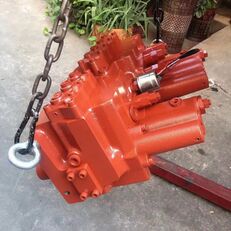
Distributeur hydraulique pour midi pelle Hitachi EX215


Si vous décidez d'acheter un véhicule ou du matériel à bas prix, assurez-vous que vous communiquez avec un vendeur réel. Cherchez autant d'informations sur le propriétaire que possible. Un escroc peut se faire passer pour une société réelle. En cas de doute, contactez-nous en utilisant le formulaire de commentaires afin que nous effectuions un contrôle supplémentaire.
Avant d'effectuer un achat, étudiez attentivement plusieurs offres de vente afin de connaître le coût moyen du modèle de véhicule ou d'équipement que vous avez choisi. Si le prix de l'offre qui vous intéresse est très inférieur aux offres similaires, réfléchissez bien. Une différence de prix considérable peut indiquer la présence de défauts cachés ou une tentative d'escroquerie.
N'achetez pas de produits dont le prix est trop différent du prix moyen de produits similaires.
Ne consentez pas à payer une caution ou une avance douteuse. En cas de doute, n’hésitez pas à demander des précisions, des photos et des documents supplémentaires, vérifier l'authenticité des documents ou encore poser des questions.
C'est l'arnaque la plus répandue. Des vendeurs malhonnêtes peuvent demander une avance sur le montant total pour « réserver » votre achat. De cette manière, ils peuvent recueillir un montant considérable, puis disparaître.
- Faire un prépaiement sur la carte
- N'effectuez pas de prépaiement sans établir de documents confirmant le transfert d'argent si le vendeur vous semble suspect au cours de vos échanges.
- Transfert de l'argent sur le compte séquestre
- Méfiez-vous de ce genre de demandes, il est très probable que vous soyez en train de communiquer avec un fraudeur.
- Virement sur le compte d'une société avec un nom similaire
- Soyez vigilant(e), des fraudeurs peuvent se faire passer pour des entreprises connues en introduisant des modifications mineures dans le nom. Ne transférez pas d'argent en cas de doute sur le nom de l'entreprise.
- Substitution de ses propres coordonnées dans la facture d'une entreprise réelle
- Avant d'effectuer le virement, vérifiez que les coordonnées indiquées sont exactes et qu'elles appartiennent à l'entreprise indiquée.
Coordonnées du vendeur

 +86 189 289...
+86 189 2896 5241


 Chine

 Chine
 Chine


 Chine


 Chine


 Chine


 Chine


 Chine


 Chine


 Chine
Product Overview
Older excavators get judged in the workshop, not on the job. A machine with a sound engine, a straight undercarriage and no structural cracks is a candidate for another few years of work; one with worn hydraulics is often written off, because the cost of a full hydraulic overhaul looks larger than the machine's resale value. That judgement is frequently wrong. On an EX215, the pump and cylinders are usually still serviceable, and the part that decides the machine's fate is the distribution valve — the one assembly nobody checks because it cannot be inspected from outside.
This distribution valve divides pump flow among boom, arm, bucket, swing, travel and auxiliary on the EX215 platform. When spools and bores wear, output falls away quietly: the boom sags on a held bucket, the arm loses bite, swing lands short, travel bogs under load. This aftermarket assembly replaces the block complete with fresh internals set to working values, so the worn unit comes off and the replacement fits the original port positions.
Core Advantages
1. Changes the verdict on an older machine
Where the engine and structure are sound, a fresh block often returns the machine to useful work for a fraction of a full hydraulic overhaul.
2. Restores force at the cutting edge
Renewed spools put pressure back into the arm and bucket, so the machine digs rather than labouring.
3. Loads hold while grade is checked
Drift on a held bucket forces constant lever pressure. Fresh pairs keep the load steady.
4. Swing placement becomes predictable
Restored circuit isolation ends the overshoot habit that costs time on every placement.
5. Complete assembly avoids investing in a machine that still underperforms
Section‑by‑section repair can consume the budget while leaving the weakest circuit untouched. One tested block settles all of them.
Manufacturing & Quality Control
Spool and bore pairs are machined to print tolerance, matched by size, and hand‑run‑in until full‑stroke movement is free of binding. Assembled blocks are flow‑tested circuit by circuit with relief values logged against platform figures; out‑of‑window units are stripped and corrected. Blocks ship internally oil‑fogged, ports capped, and crated on foam.
Frequently Asked Questions
Q1: My machine has no part number listed — how do I order?
A: Send clear photos of the existing valve, its tag if present, and the machine serial plate. Section count, porting and mounting pattern identify the variant.
Q2: How do I decide whether the machine is worth a new block?
A: Check engine condition, undercarriage wear and structural cracks first. If those are sound and only hydraulics are weak, a block is usually the cheapest route back to work.
Q3: What symptoms indicate valve wear?
A: Boom drift on held loads, lost arm force at the bottom of a cut, inconsistent swing, and travel that reacts to bucket load.
Q4: Can my existing block be rebuilt?
A: If the casting is sound and has never been rebuilt, a kit may restore it. On a machine with several worn circuits, a complete assembly is usually the better value. Photos help us judge.
Q5: What hydraulic servicing accompanies installation?
A: Flush the system, renew filters, clean the suction strainer, refill with specified oil, and verify relief settings before returning to production.
Q6: What is excluded from warranty?
A: Material and assembly faults are covered. Damage from dirty oil, water ingress, a spool forced against a bind, or reliefs altered outside specification is not. Photograph the crate before opening if damage is visible.